

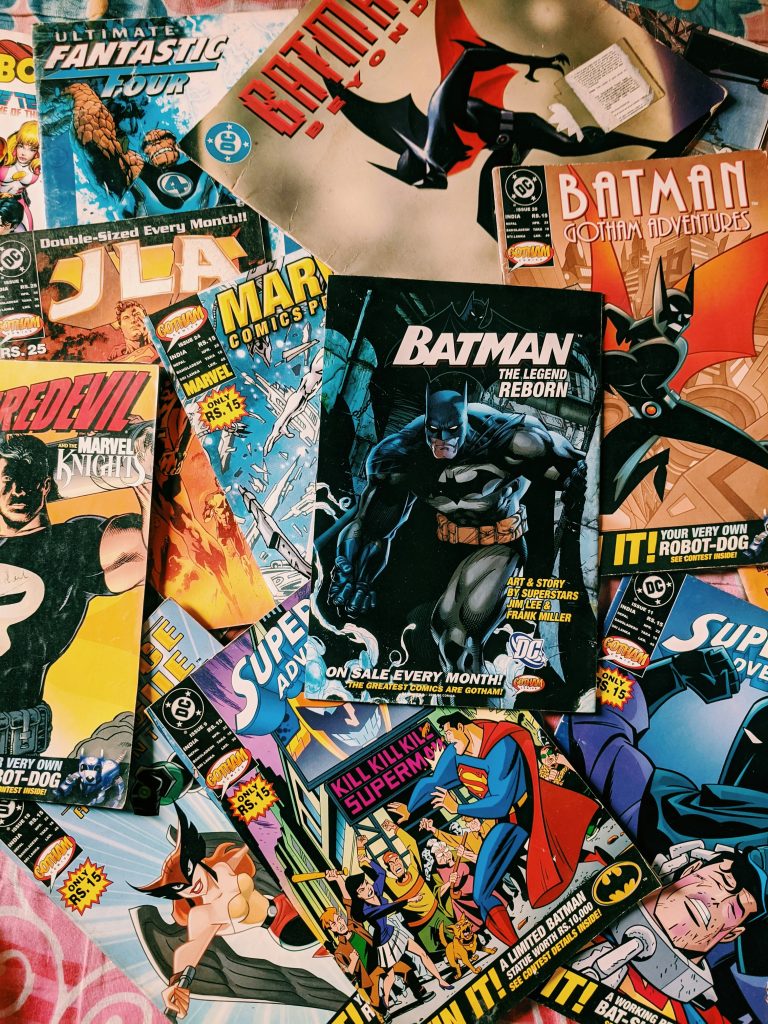
I was walking down the street on a cold day in Brussels when the sight of Tintin and Snowy in a window display caught my eye and made me feel at home in my foreign surroundings. Decades earlier, George Remi, (pen name Hergé)) had traversed borders and continents and brought adventure to my younger self through his well-known comic book series. Perhaps, comic book characters are dearer to us than storybook characters because their escapades fill volumes. Back in the day, they were also a visual treat when these delights were limited. From the age of 5 through 16, I spent a number of hours, either relaxing or convalescing in bed with a pile of comic books. Clearly, the characters were created to remain imprinted in our minds. I enjoyed Little Dot and her (you guessed it) obsessive love for dots and her friend Little Lotta and her tremendous strength. Then there was pitiful Sad Sack or animated Garfield- after all who doesn’t love an underdog or a smart-aleck cat? And of course, the trials of adolescent angst were best conveyed through The Archies group. Most of all I wouldn’t mind revisiting those piles of money with ‘poor little rich boy’ Richie Rich, who had a dog called Dollar with dollar signs on his fur!
Later, there came a time when I skimmed through newspaper headlines (after all how much political/economic chaos can one handle) and then chortled leisurely over the comic strips. Hi and Lois chronicled the daily struggles of the American suburban family but it was relatable to everyone. Also, Charlie Brown and Snoopy brought a daily dose of comic-satire to 2500 newspapers in 75 countries at the time of its creator Schulz’s demise. Beetle Bailey created by Mort Walker and set on a fictional US army post, focused on the power dynamics between Sergeant Snorkel (a tough supervisor) and Beetle (the goofy subordinate) an easily identifiable duo. B.C., by Johnny Hart, Hagar the Horrible, by Dik Browne and Chris Browne- all enabled us to view life from a quasi- humorous perspective, almost saying: if you can’t cry about it, laugh.
In the words of Bill Watterson, creator of the hugely popular Calvin and Hobbes comic strip: ‘Calvin is autobiographical in the sense that he thinks about the same issues that I do. Calvin reflects my adulthood more than my childhood.’ This explains why comic strips make existential observations. Almost subliminally, the characters prepare us for the unfairness of an adult world. Moreover, fantasy grew in leaps and bounds with the advent of the superheroes/heroines. Mandrake the Magician (debuted in 1934) was created by Lee Falk who went on to create Phantom (first appearing in 1936). Then other heroes evolved; Superman and Batman and so on. Today, we all know that comic books have their own convention called-Comic-Con.
Several series dabbled with lofty subjects like history and mythology. France gave us- The Adventures of Asterix- stories of the Gauls’ resistance to Roman occupation, Indians have mythological comic books called Amar Chitra Katha, (immortal picture stories) and the Japanese introduced us to Manga comics -traditionally written from right to left. The list of comic books and their worlds is too large to accommodate in a paragraph. On the whole, with their bulbous eyes, bright hair and signature attire, comic book characters are like caricatures of ourselves, except that they are allowed to be quirky. Humour, satirical and otherwise carries us through their dilemmas without weighing us down with them. They are resigned to the ways of the world but open to the little wonders in it. It’s as though they’ve been telling us to be wise and child-like at the same time. Every so often I still remember Alfred E. Neuman of Mad magazine with his toothy grin and devil-may-care attitude. His famous words, “What, me worry?” are a refrain to live by.
Share this :